




Most people say they want growth when what they really want is relief. They want the business to get easier. They want the uncertainty to settle down. They want one smart move, one good quarter, one clear signal that the hard part is behind them. That’s understandable. It’s also not how this works. The pressure doesn’t go away. It just changes form.
That’s part of why I’ve grown skeptical of how often innovation gets framed as the answer. We treat progress like it belongs to whoever comes up with the freshest idea or the boldest pivot. But most businesses aren’t stuck because they lack imagination. They’re stuck because what they claim to be and what they consistently deliver don’t quite line up. The message drifts. The execution slips. Things that used to work stop working, and no one wants to slow down long enough to figure out why.
Iteration doesn’t get much attention because it sounds smaller than innovation. It feels like settling. In reality, it’s the opposite. It’s the willingness to stay with something long enough to make it sharper, clearer, more reliable. Not by overhauling everything at once, but by tightening what’s already there and being honest about what isn’t holding up. It rarely looks like progress from the outside, but it's usually where the real leverage is.
That tension is only getting more pronounced. Tools like AI make it easy to produce — faster, cheaper, and in higher volume than ever before. That’s useful, up to a point. But output on its own doesn’t solve much. If anything, it raises the bar on judgment. The teams that benefit from this moment won’t be the ones pushing the most into the world. They’ll be the ones paying close attention to what actually lands and adjusting accordingly.
Where things tend to break down is in the middle. Founders get caught between what they’ve already built and what they think they should be building next. They stay busy, but the work starts to scatter. One week it’s a new angle, the next week it’s a new channel, then a new offer. None of it gets enough time to prove itself, so nothing really sticks. It creates the feeling of effort without much forward movement.
In our recent conversation with Eggs! The Podcast guest and CEO at Afterburner, Chris Boucousis, is how little patience he has for that kind of drift. He talks about iteration as a structured way of operating, not a vague idea about improvement. His background as a fighter pilot shapes that perspective — when things are moving quickly, you don’t have the luxury of guessing your way through decisions. You need a clear destination, an honest read on where you are, and a way to close the gap. Then you do it again. Strip away all the noise around entrepreneurship, and that’s still one of the more dependable ways to make progress. Chris has spent years applying that thinking in business, and it comes through clearly in his approach to growth.
What High Performers Do Differently

Chris Boucousis didn’t come up through the usual business channels. He started in a cockpit. He spent over a decade in the Australian Air Force flying high-performance fighter jets, where hesitation isn’t just costly — it’s fatal. That environment leaves no room for vague goals or half-formed plans. You define the mission, assess reality, and act with precision.
When an autoimmune disease cut his flying career short at 30, Boucousis was forced into an abrupt transition — one that ultimately led him into entrepreneurship. His first venture, launched in Afghanistan in the mid-2000s, scaled rapidly amid chaotic conditions, growing into a multi-thousand-person operation that managed complex logistics and infrastructure projects. It wasn’t polished. It wasn’t predictable. But it reinforced something he had already learned as a pilot: progress comes from constant adjustment, not perfect planning.
Today, as CEO of Afterburner, Boucousis works with organizations around the world to apply that same mindset to business. His focus is straightforward — help leaders operate with more clarity, move faster without losing discipline, and build systems that improve over time instead of breaking under pressure. What he brings isn’t theory. It’s a repeatable way of thinking, forged in environments where getting it wrong wasn’t an option.
The Mechanics of Momentum
If innovation gets the spotlight, iteration does most of the real work. Chris kept coming back to a point that a lot of founders need to hear: growth is usually less about finding the brilliant next idea and more about improving what’s already in motion. These were a few of the sharpest moments from the conversation.
“You’ve got to be focused on where you’re going… and really honest about where you are. Then you have to keep trying something new.”
Actionable insight: Most businesses don’t need more ambition; they need a tighter loop between target, reality, and response. If you’re clear on the destination but fuzzy on your current position, you’re not iterating — you’re guessing.
“Take something and make it a little better tomorrow… then take that and make it a little better again the next day.”
Actionable insight: It sounds simple, which is exactly why it gets overlooked. But steady improvement, applied consistently, is still one of the few advantages that compounds over time.
“Every time I tried to hustle, it went bad. Every time I stuck to the basics, it went well.”
Actionable insight: A lot of effort gets wasted chasing momentum instead of building it. The better move is usually quieter — refine what already works before reaching for something new.
“People don’t actually want constant change… they want consistency. They want to know that if they buy something, it’s what you say it is.”
Actionable insight: This is where many brands lose ground. Reinvention feels productive internally, but externally it can look like instability. Consistency builds trust faster than novelty.
“We tend toward doing things… not achieving things.”
Actionable insight: Activity is easy to justify, especially when you’re busy. But if the work isn’t tied to a clear outcome, it’s just motion — and motion doesn’t scale.
“If it feels like the work isn’t going anywhere… it probably isn’t.”
Actionable insight: That instinct is usually right. The challenge is acting on it early enough to redirect your effort toward something that actually moves the business forward
“Best known is better than best.”
Actionable insight: Perfection is a poor strategy if no one sees the product. Visibility, clarity, and feedback will do more for growth than another round of internal improvements.
Staying in the Loop
There’s a version of this conversation that turns into motivation. Work harder. Stay disciplined. Keep going. That’s not really the point. Most people already know they need to do those things. The gap is usually somewhere else. It’s in how the work is structured. It’s in whether there’s a real feedback loop, or just a constant stream of activity that never quite gets examined.
Iteration, done properly, forces that examination. It asks you to define what you’re actually trying to achieve, measure where you stand, and make a decision about what changes next. Not everything at once. Just the next move. That sounds simple, but it requires a level of honesty that many businesses avoid. It’s easier to stay busy than it is to admit something isn’t working and adjust it in real time.
The advantage, if you’re willing to operate this way, is that progress becomes a lot less mysterious. You stop waiting for the breakthrough and start building momentum on purpose. It may not look dramatic from the outside, but over time, it’s the difference between a business that stalls and one that builds on itself over time.
Thanks for reading.
—Ryan
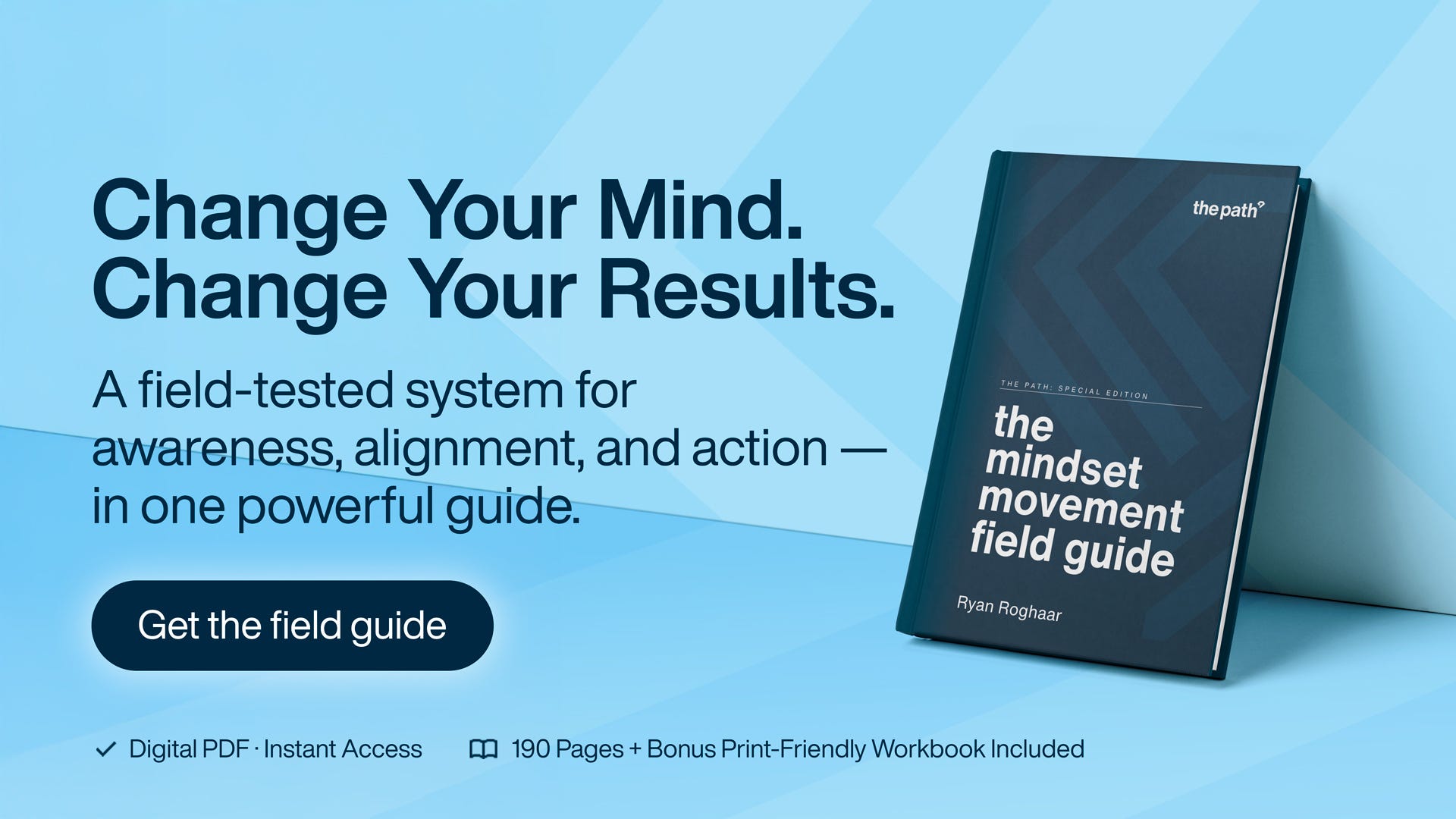
If you’re ready for life to feel more intentional, more aligned, and more within your control, this guide gives you the structure to make that shift real. Your next version starts with a single decision. Get the field guide
The Path is sponsored by: Taelor Style

A better way to dress for men on the go
Taelor is a subscription menswear service built for professionals and men on the go. Using AI and real stylists, Taelor curates outfits that fit your lifestyle—no shopping, no laundry, no decision fatigue. If you want to look sharp without spending mental energy on it, use code PATH at checkout for 25% off your first order.
Ready for more?
Catch Nick Avaria’s interview in its entirety on Eggs! The Podcast.
Don’t miss a show! Subscribe on Spotify, Apple Podcasts, or really anywhere great podcasts are found.
Path Picks
Cool stuff to help you forge your path to greatness.
Note: The Path Weekly is reader-supported. As such, I may be using affiliate links below. If you want to support the newsletter at no additional cost to you, please consider using the links below. If you’d rather not, most items below are widely available anywhere you want to shop. Thanks! –R
Reading list
If you're looking to go deeper on the themes from this week's newsletter, here are a few books that pair well with the conversation and offer a broader perspective:
Atomic Habits — James Clear
Clear’s core idea is simple: small improvements, applied consistently, outperform big, sporadic changes. It’s probably the most accessible entry point into understanding why iteration works—and why most people abandon it too early.The Lean Startup — Eric Ries
This is the closest thing to a formal framework for what Chris is describing. Build, measure, learn. Not glamorous, but highly effective when actually followed instead of just referenced.The Checklist Manifesto — Atul Gawande
A great reminder that consistency beats brilliance in high-stakes environments. Surgeons, pilots, and operators rely on repeatable systems—not inspiration—to get things right.Deep Work — Cal Newport
If iteration is the strategy, focus is the requirement. Newport makes a strong case that the ability to concentrate without distraction is becoming one of the most valuable skills in modern work.Good Strategy/Bad Strategy — Richard Rumelt
This one helps separate real progress from noise. Rumelt breaks down what effective strategy actually looks like—and why most organizations avoid it in favor of vague ambition.
More to explore
Afterburner Inc — Chris Boucousis’ firm bringing fighter pilot frameworks into business
Flawless Leadership — His latest thinking on execution, leadership, and performance
Chris Boucousis — More from Chris on leadership and iteration principles
Would you like a personal introduction to this or any of the incredible leaders featured in The Path Weekly to explore business or other collaborative opportunities?
Contact me here to learn more about my B2B matchmaking service.
Want to put your brand in front of 13,000+ business and technology leaders each week? Contact me to learn more about sponsorship opportunities.
Work with me
RŌG Health - A commercial readiness and strategy firm for medtech companies, helping CEOs identify what’s blocking growth and make clear, de-risked decisions around commercialization, partnerships, and fundraising.
https://roghealth.com
Ryan Roghaar - Artist/Creative Director/Author
https://ryanroghaar.com
Eggs! The Podcast - https://www.eggscast.com
Get featured
Do you want to be featured in a future edition of The Path Weekly?
Contact me to learn more.