




Most people don’t think about intellectual property until something goes wrong. A client relationship goes sideways. A contractor disappears. A competitor launches a brand that looks suspiciously similar to yours. Or you suddenly realize you’ve spent years creating value—but you can’t clearly explain what you actually own. In my experience in “agency-world,” that happens more than people like to admit because we tend to treat our work like output instead of assets. We ship the logo, the campaign, the deck, the website, and then move on to the next job. But the longer I’ve been in business, the more I’ve realized something simple: if you’re running a knowledge business, you’re not just delivering services—you’re running an intellectual property factory.
One of the biggest misconceptions—especially for creative people—is the idea that “I made it, so I own it.” Its equally common cousin is “I paid for it, so I own it.” In practice, both of those assumptions can get messy fast. If freelancers, contractors, partners, stock assets, templates, or outside tools were involved in the creation of something, you’ve introduced other parties into the ownership chain. The issue isn’t just legal theory—it’s leverage. Ownership is what allows you to reuse, repackage, license, defend, or sell the things you’ve built. If the ownership story is fuzzy, the business story gets fuzzy too.
What’s interesting is that most founders don’t start businesses thinking about intellectual property at all. They start because they’re good at something. A designer starts designing. A consultant starts consulting. A developer starts building software. For years, that’s exactly how I approached things in my own agency work. I was focused on the craft and the client outcomes, not necessarily on how the knowledge, systems, and ideas behind that work might become assets of their own. But over time, you start to realize that the real long-term value often lives in the patterns you’ve developed, the frameworks you’ve built, and the ideas you’ve refined—not just the one-off deliverables.
Part of what I love about writing this newsletter is that it lets me leverage intellectual property from another project I run—EGGS The Podcast. Every week we have long conversations with CEOs, founders, marketers, and innovators. Those conversations are valuable in their own right, but they also contain insights, frameworks, and ideas that deserve more than a single listen. By translating those conversations into newsletters like this one and placing additional focus on the key moments, I’m able to highlight ideas that might resonate differently with readers than they do with listeners. And that same core content can live in multiple forms—podcast episodes, newsletter essays, speaking topics, or even the podcasting course I’m currently building. Same intellectual property, different expressions of value.
That’s where things get especially interesting in the current moment, because tools like AI have made it easier than ever to generate content quickly. But speed and ownership are not the same thing. If a piece of work is entirely AI-generated, the ownership story becomes far less clear. And even when AI is used as a helper, questions about provenance, platform terms, and originality still matter. The temptation right now is to create more, faster, and cheaper. The smarter move is deciding which work is disposable and which work is a long-term asset—and being intentional about how those assets are created and protected.
All of this is why I was excited to sit down recently with Sharon Toerek on EGGS The Podcast. Sharon is a trademark and intellectual property attorney who works closely with agencies and other knowledge-based businesses—companies that are often creating valuable IP every single day without realizing it. Our conversation covered everything from common misconceptions around ownership to how founders can think more strategically about protecting and monetizing the ideas, systems, and creative work they’re already producing. If you’ve never really stopped to think about intellectual property as part of your business strategy, Sharon has a way of making the topic both practical and surprisingly relevant.
Seeing Business Through an IP Lens

Sharon Toerek is a trademark and intellectual property attorney and the founder of Toerek Law, a firm that works closely with marketing agencies and other knowledge-based businesses across the United States. Much of Sharon’s work focuses on helping companies protect the ideas, creative work, and systems that power their businesses—everything from trademarks and copyrights to contracts that govern how that work gets used and monetized. Over the years, she has developed a reputation for translating complex legal concepts into practical strategies that founders and agency leaders can actually apply.
One of the ways Sharon does that is through a framework she calls the IP Triangle—a simple lens for identifying the intellectual property that exists inside almost any business. At one point of the triangle is Brand: the names, slogans, and identifiers that signal who you are in the marketplace. Another point is Content: the creative or knowledge-based work you produce, whether that’s marketing campaigns, code, training materials, video, or written ideas. The third point is Transactions: the agreements and contracts that determine how that work is used, who owns it, and how it ultimately generates revenue.
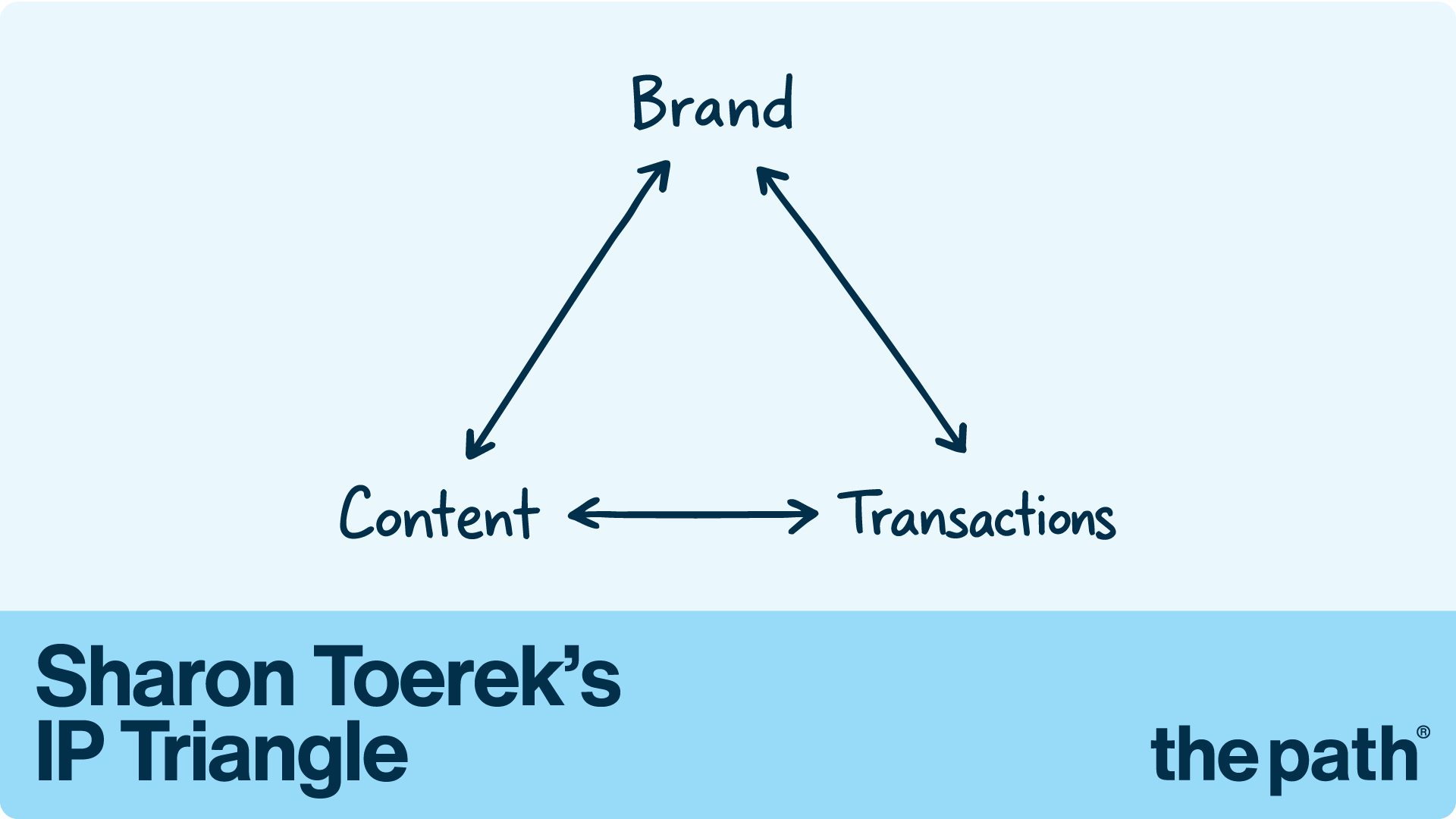
The power of the triangle is that it makes something abstract feel visible. Instead of thinking about intellectual property as something reserved for tech companies or patent filings, Sharon encourages founders to see how much IP they are already producing every day. Once you start looking at your business through that lens, the conversation shifts—from reacting to problems after they happen to intentionally building and protecting assets that can grow in value over time.
Supercharging your IP factory
A few moments from my conversation with Sharon that reframed how I think about intellectual property inside a modern knowledge business.
“Legal for entrepreneurial companies should be regarded as a profit-making tool, a profit preservation tool… it’s intertwined with your ability to make and keep the money that your business is set up to earn for you.”
Actionable insight:
Most founders treat legal as an expense that shows up when something breaks. A better approach is to view legal structure as part of your revenue strategy—especially when your products are ideas, systems, and creative work.
“Most entrepreneurial companies undervalue the amount of IP they are creating on a day-to-day basis… it’s often their most significant asset.”
Actionable insight:
If you run a marketing agency, consultancy, course business, or software company, you are creating intellectual property constantly. The real question isn’t whether you have IP—it’s whether you’re documenting and protecting it.
“The misunderstanding is that if I paid somebody to create work for my company… I own that. Which is not the way the United States regards copyright law.”
Actionable insight:
Contractors, freelancers, and collaborators introduce ownership complexity. Without written agreements assigning rights to your company, the work may legally belong to the person who created it.
“You should be sitting down and doing an audit of your IP on a regular basis… look at the three points of the triangle.”
Actionable insight:
Sharon’s IP Triangle offers a simple audit:
• Brand — your name, marks, and identifiers
• Content — the work you produce
• Transactions — the contracts governing its use
If any corner is weak, your ownership story becomes harder to defend..
“The more you do along the way to build the legal fortress around your intellectual property… the more it’s going to be worth when you go to sell your company.”
Actionable insight:
Intellectual property doesn’t just protect what you’ve built—it increases enterprise value. Buyers, investors, and partners all look for clear ownership of assets before committing capital.
“The potential for creating a revenue stream that stands alongside your fee-for-service revenue… comes from intellectual property.”
Actionable insight:
Agencies often overlook the systems they’ve already built. Frameworks, training, tools, and methodologies can become courses, licensing models, or subscription products that generate revenue independent of billable work.
“The more shortcuts you take, the less value your innovation has.”
Actionable insight:
Tools like AI can speed up creation, but speed alone doesn’t build durable assets. Decide which work is disposable and which work is meant to become long-term intellectual property—and treat them differently.
Treat Your Ideas Like Assets
The thread running through Sharon’s perspective is pretty straightforward: most knowledge businesses are producing valuable intellectual property whether they realize it or not. The question is whether you treat those ideas as disposable output or as assets that deserve a little structure and protection.
Once you start looking at your business through that lens, the shift is subtle but important. Instead of simply delivering work and moving on, you begin to notice the frameworks, systems, and insights that could live beyond a single project or client engagement. Some of them might become products. Others might turn into teaching, licensing, or partnerships. At the very least, they become building blocks you can keep.
And in a world where tools can generate more content faster than ever, that distinction matters. Anyone can produce more “stuff.” The real opportunity is deciding which ideas are worth owning.
Thanks for reading,
—Ryan
If you’re ready for life to feel more intentional, more aligned, and more within your control, this guide gives you the structure to make that shift real. Your next version starts with a single decision. Get the field guide
The Path is sponsored by: Taelor Style

A better way to dress for men on the go
Taelor is a subscription menswear service built for professionals and men on the go. Using AI and real stylists, Taelor curates outfits that fit your lifestyle—no shopping, no laundry, no decision fatigue. If you want to look sharp without spending mental energy on it, use code PATH at checkout for 25% off your first order.
Ready for more?
Catch Sharon Toerek’s interview in its entirety on Eggs! The Podcast.
Don’t miss a show! Subscribe on Spotify, Apple Podcasts, or really anywhere great podcasts are found.
Path Picks
Cool stuff to help you forge your path to greatness.
Note: The Path Weekly is reader-supported. As such, I may be using affiliate links below. If you want to support the newsletter at no additional cost to you, please consider using the links below. If you’d rather not, most items below are widely available anywhere you want to shop. Thanks! –R
Reading list
If you're looking to go deeper on the themes from this week's newsletter, here are a few books that pair well with the conversation and offer a broader perspective:
Intellectual Property: The Tough New Realities That Could Make or Break Your Business — Paul Goldstein
A business-minded look at trademarks, copyrights, trade secrets, and how to think about IP when your competitive advantage is ideas.Built to Sell — John Warrillow
Not an IP book, but it’s extremely relevant: it’s about building a company that can stand apart from the founder—often by packaging know-how, process, and repeatable “method” into something transferable.Patent It Yourself — David Pressman (Nolo)
More patent-specific than this newsletter needs, but it’s a solid example of what “practical, step-by-step IP guidance” looks like—useful if your audience includes inventors, product builders, or anyone sitting on potentially patentable work.
More to explore
Legal+Creative - Sharon Toerek’s Official Site: https://legalandcreative.com
Contact Mike: https://www.linkedin.com/in/sharontoerek/
Would you like a personal introduction to any of the incredible leaders featured in The Path Weekly to explore business or other collaborative opportunities?
Contact me here to learn more about my B2B matchmaking service.
Want to put your brand in front of 13,000+ business and technology leaders each week? Contact me to learn more about sponsorship opportunities.
Work with me
Ryan Roghaar - Fractional CMO/Creative Director/Art Director: https://ryanroghaar.com
RŌG Health - A commercial readiness and strategy firm for medtech companies, helping CEOs identify what’s blocking growth and make clear, de-risked decisions around commercialization, partnerships, and fundraising. https://roghealth.com
Eggs! The Podcast: https://www.eggscast.com
Get featured
Do you want to be featured in a future edition of The Path Weekly?
Contact me to learn more.