




Most marketing problems don’t start with bad copy. They start earlier, and quieter, with unclear thinking.
When a business struggles to convert, the instinct is to look at the words. Rewrite the headline. Add another call to action. Increase urgency. Try a different tone. But those moves assume the problem lives on the surface. In my experience, it rarely does. More often, the business hasn’t decided what it’s actually asking for—or who it’s asking.
That uncertainty shows up everywhere. Pages that try to do five jobs at once. Emails that hedge instead of point. Funnels that add steps because no one trusts the offer to stand on its own. The result is volume without direction. Plenty of activity, very little momentum.
One of the fastest ways to restore that alignment is to stop thinking in terms of selling and start thinking in terms of helping. Not in the abstract—but concretely. Helping who, with what, at this exact moment. That question has a way of eliminating unnecessary copy, extra CTAs, and fuzzy offers on its own.
Good marketing is usually less about persuasion than alignment. When the thinking is clear—this is the problem, this is who it’s for, this is what happens next—the copy almost writes itself. When the thinking is muddled, no amount of clever phrasing fixes it. It just hides the issue longer.
This is where concepts like “kindness” or “trust” get misunderstood. They aren’t tone choices. They’re structural outcomes. A clear offer feels respectful because it doesn’t force the reader to work to understand it. A transparent process feels trustworthy because nothing surprising happens halfway through. That’s not empathy as branding—it’s competence.
The same logic applies to friction. People talk about removing it as if that’s always the goal. It isn’t. Friction is a lever. Sometimes you reduce it to increase volume. Sometimes you add it to improve commitment. The mistake is not choosing. Indecision creates the worst version—friction without intention.
AI has made this gap more visible. It’s never been easier to generate words, and never been more obvious when those words aren’t anchored to a clear idea. You can feel when something was written to fill space instead of express a position. The problem isn’t that AI writes badly. It’s that it exposes when no one did the thinking first.
The businesses that are working right now tend to be unremarkable in the best way. One clear ask. One defined next step. Fewer explanations. Less noise. They don’t feel aggressive or gentle—they feel decided.
This week’s featured expert, recent Eggs! The Podcast Guest, and founder at Kind Copy has spent years helping people identify where clarity breaks down, long before the words ever hit the page. And that perspective changes how you think about marketing entirely.
From Psychology to Copy: Where Clarity Actually Comes From

Before founding Kind Copy, Cath Reohorn spent more than a decade teaching psychology in schools and colleges. Her work focused on how people understand emotion, make decisions, and change behavior—not in theory, but in practice. That background shaped how she later approached marketing: not as persuasion, but as decision-making—clarifying what the business had failed to decide before the copy ever existed.
After her time in academia came to a close, Cath moved into self-employment, first as a personal trainer. When her business shifted online during COVID, she ran into the same problem many founders do: suddenly, success depended on standing out, communicating clearly, and earning trust without proximity. She learned copywriting out of necessity, not ambition—and discovered she was far better at helping others articulate their message than selling her own services directly.
Kind Copy grew out of that tension. Working primarily with founders in fitness, coaching, and creative fields, Cath developed a reputation for cutting through bloated messaging and pressure-driven funnels. Her work is less about finding the perfect words and more about identifying where thinking has gone soft—where too many options, too much copy, or poorly defined asks are getting in the way of action.
What makes her perspective distinct isn’t a new framework or clever language. It’s the ability to see marketing problems upstream—before they turn into copy problems at all.
Where Marketing Actually Breaks Down
What follows aren’t tactics in isolation. They’re pressure points—places where unclear thinking quietly turns into bad copy, bloated funnels, or stalled growth.
“Most of the time, I used to think my value was that I could write really good copy. Increasingly, I’m starting to see that it’s less about the copy and more about thinking really clearly about the problem.”
Actionable insight:
Before you touch the words, force clarity on the problem. If you can’t state—out loud—what this page, email, or offer is responsible for, rewriting it won’t help.
“People come to me and say, ‘I need more leads.’ And I’m like, okay—are people actually seeing your stuff?”
Actionable insight:
Don’t jump to conversion fixes when you have a visibility problem. Diagnose reach before refining messaging, or you’ll optimize something no one sees.
“If you don’t bring objections up in the sales call, they’ll bring them up later—without you in the room.”
Actionable insight:
Proposals don’t fail because they’re unclear; they fail because unspoken doubts linger. Surface the hard questions early, while you still have context and credibility.
“Is it clear who you’re speaking to, and is it clear what you want them to do on that page?”
Actionable insight:
Every asset should answer two questions instantly: Who is this for? and What happens next? If either answer is fuzzy, performance will be too.
“One of the biggest mistakes I see is too many calls to action. If they don’t do this, maybe they’ll do that. And it just becomes a muddle.”
Actionable insight:
Multiple CTAs don’t create optionality—they create indecision. Pick one outcome per page and measure it cleanly.
“I wasn’t writing copy. I was removing copy.”
Actionable insight:
When conversion drops, try subtraction before addition. Extra explanation is often compensating for a decision the business hasn’t made.
“Friction is something you’re always playing with—adding it or removing it depending on what you need.”
Actionable insight:
Stop treating friction as a flaw. Decide whether you want volume or commitment, then design the process accordingly. Unintentional friction is the real enemy.
“People want a call because they’re uncertain about the process they’re in.”
Actionable insight:
Sales calls aren’t mandatory if clarity exists elsewhere. Explain what will happen before, during, and after each step, and many questions disappear on their own.
“The goal of content isn’t to have a lot of content. It’s to have content people actually consume.”
Actionable insight:
Publishing more is not progress. One clear idea, expressed cleanly, outperforms volume every time—especially in a crowded market.
“When people realize they’re reading AI, their interest switches off immediately.”
Actionable insight:
AI can assist analysis, but it can’t replace thinking. If your content doesn’t sound like someone decided something, trust will erode faster than silence.
“One of the simplest shifts I made was to stop thinking about selling and start thinking about helping.”
Actionable insight:
If you’re struggling to clarify an offer, ask who you’re actually trying to help and what problem they already know they have. That constraint does more work than any headline rewrite.
When the Words Aren’t the Problem
It’s tempting to believe that better marketing lives one rewrite away. A stronger headline. A cleaner CTA. One more pass through the copy. Sometimes that helps. Most of the time, it doesn’t.
What Cath keeps pointing back to—explicitly or not—is that the work usually starts earlier. Before the page. Before the email. Before the funnel. Someone has to decide what this thing is doing, who it’s for, and what happens next. When that decision hasn’t been made, the language starts compensating. More words. More options. More explanation.
The opposite move isn’t polish. It’s commitment. Fewer ideas. Fewer asks. Less tolerance for ambiguity. When that happens, marketing stops feeling like persuasion and starts functioning more like a system. One step leads to the next. Nothing extra.
Most businesses don’t need better copy. They need to decide.
Thanks for reading,
—Ryan
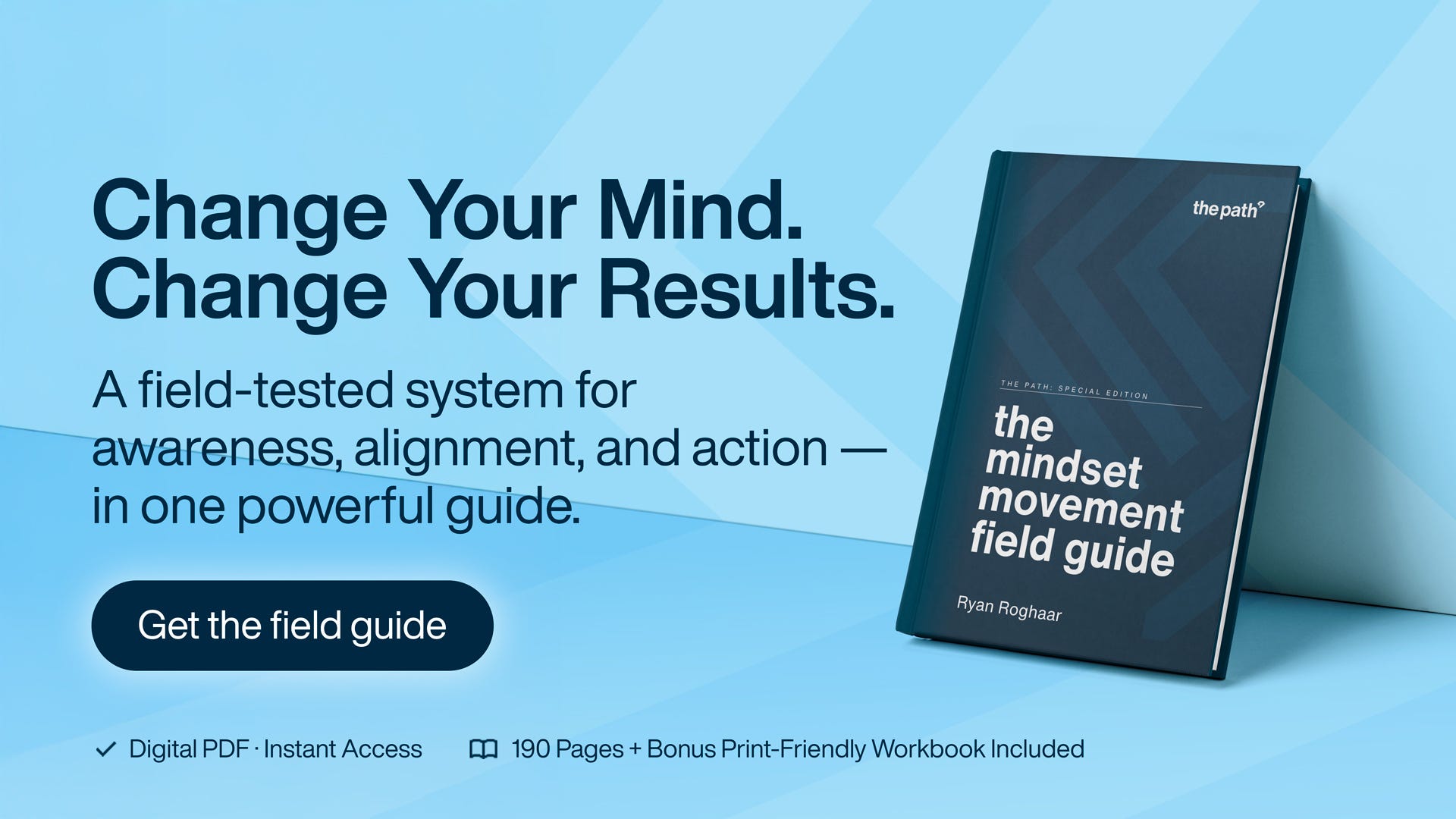
If you’re ready for life to feel more intentional, more aligned, and more within your control, this guide gives you the structure to make that shift real. Your next version starts with a single decision. Get the field guide
The Path is sponsored by: Taelor Style

A better way to dress for men on the go
Taelor is a subscription menswear service built for professionals and men on the go. Using AI and real stylists, Taelor curates outfits that fit your lifestyle—no shopping, no laundry, no decision fatigue. If you want to look sharp without spending mental energy on it, use code PATH at checkout for 25% off your first order.
Ready for more?
Catch Cath Reohorn’s interview in its entirety on Eggs! The Podcast.
Don’t miss a show! Subscribe on Spotify, Apple Podcasts, or really anywhere great podcasts are found.
Path Picks
Cool stuff to help you forge your path to greatness.
Note: The Path Weekly is reader-supported. As such, I may be using affiliate links below. If you want to support the newsletter at no additional cost to you, please consider using the links below. If you’d rather not, most items below are widely available anywhere you want to shop. Thanks! –R
Reading list
If you're looking to go deeper on the themes from this week's newsletter, here are a few books that pair well with the conversation and offer a broader perspective:
Thinking in Bets — Annie Duke
A clear-eyed look at how decisions actually get made under uncertainty. Duke reframes outcomes, risk, and confidence in ways that map directly to marketing and business strategy—especially when leaders confuse effort with clarity.Made to Stick — Chip Heath & Dan Heath
Often misread as a “copywriting” book, this is really about disciplined thinking. The ideas that stick do so because they’re decided, constrained, and specific—not because they’re clever.Clear Thinking — Shane Parrish
A book about removing blindspots, noise, and unnecessary complexity. Parrish’s work aligns closely with this week’s theme: better outcomes come from fewer, better decisions—not more activity.On Writing — Stephen King
Not a business book—and that’s the point. King’s emphasis on clarity, revision through subtraction, and respect for the reader mirrors many of the lessons Cath applies to modern marketing.The Mom Test — Rob Fitzpatrick
A practical guide to asking better questions and avoiding false validation. Essential reading for anyone who thinks they have a marketing problem when they actually have a discovery problem.
More to explore
Kind Copy - https://kindcopy.co.uk
Cath on Substack: Cath Reohorn
Work with me
Ryan Roghaar - Fractional CMO/Creative Director/Art Director: https://rogha.ar/portfolio
RŌG Health - A commercial readiness and strategy firm for medtech companies, helping CEOs identify what’s blocking growth and make clear, de-risked decisions around commercialization, partnerships, and fundraising. https://roghealth.com
Eggs! The Podcast: https://www.eggscast.com
Would you like a personal introduction to any of the incredible leaders featured in The Path Weekly to explore business or other collaborative opportunities?
Contact me here to learn more about my B2B matchmaking service.
Get featured
Do you want to be featured in a future edition of The Path Weekly?
Contact me to learn more.
This was a total pleasure to collaborate on and you hit the nail on the head for me: writing is a tool to clarify thinking
Appreciate you having me on the show!!