



So this was unexpected — a bonus edition.
As I was assembling The Mindset Movement Fieldguide, I realized I’d left something out. Not just me, either. In fact, I think everyone leaves this part out. I’ve read a million books like The Millions Within, including most of the books that inspired it. And while they’re packed with genuinely powerful mindset work, they all share one conspicuous omission: they talk endlessly about the inner shift required for wealth or transformation, but they almost never explain the part where the external results actually appear.
This isn’t a criticism of the authors — these books have changed the lives of literally millions of people for the better. It’s simply an observation. With very few exceptions, the people who write these kinds of books go on to make their fortunes by teaching the same ideas — books, programs, coaching, courses, seminars. Their success becomes the proof of the philosophy, but if you don’t want to build a career in the self-help industry, you’re left wondering: How does this translate into the life I actually want?
That question hit me as I sat down to reread Neagle’s book for the fifth or sixth time. Don’t worry, I’m still all-in. I’m seeing real changes in my own mindset and my own life every day now. But I found myself pausing on the way his story is presented in the book — the jump from earning roughly $20K a year operating a forklift to earning $60,000 a month after a pivotal mindset shift. The internal transformation is described clearly. The external progression, less so. And that pause wasn’t skepticism as much as curiosity: what actually happened in between?
Once you notice that compression, you start to see it everywhere. Think and Grow Rich does this. Wattles does this. A dozen modern authors do this. They’re deeply committed — and I think rightly — to the idea that mindset is foundational. But mindset alone doesn’t explain how someone identifies the right vehicle for growth, or how internal shifts translate into specific career moves, role changes, or structural decisions. Even in my own life, as inspired and aligned as I feel right now, there isn’t an obvious or automatic path from where I am to the income goals I’ve set. I run a small business. I have side projects. Opportunities will emerge. But it’s unlikely they’ll arrive as a single, perfectly wrapped solution. It’s far more likely that hitting those goals will require conscious pivots — possibly into different kinds of work altogether.
And I suspect that’s true for a lot of people reading this.
That’s why I wrote this bonus edition of The Mindset Movement. It’s an attempt to name the gap I’ve been circling around for years — but stumbled into again today — the gap between belief and behavior, between mindset and mechanism, and to offer a framework that helps you move from idea to execution. Because let’s be honest: adjusting your mindset, or at least reading about adjusting your mindset, is the easy part. That’s why these books are so popular. Without doing anything, it feels like you’ve done something profound. However, the real work begins when you start applying the ideas to the structure of your actual life.
I don’t think there’s any shortage of wisdom in these classics. I don’t think the promises are false. I’m seeing the effects of this work already. But manifestation doesn’t mean things simply appear. It means you become the version of yourself who goes out and gets them — and you become so internally aligned that it feels almost effortless when you do.
The essay below was written as a response to that realization. It’s my attempt to fill the gap.
—Ryan
If you’ve read this far, then you’ve done the part most people never do. You’ve engaged with your own assumptions. You’ve questioned the internal architecture behind your decisions. You’ve examined belief as a form of internal currency, traced the invisible laws that govern growth, and begun to understand how becoming is less about performance and more about alignment. Most people stop long before this point. They get inspired, underline passages, feel the rush of a new idea moving through their system, and then quietly return to the structure of the life they already have.
And if we’re being honest — brutally honest — every one of us has done some version of this. The theory is intoxicating. The internal shift feels significant. There’s a sense of clarity and momentum and possibility that is so emotionally vivid it becomes tempting to mistake it for transformation itself. But theory is only ever theory. Awareness alone doesn’t change your life. Belief, without expression, just sits there. You can read every mindset classic ever written, memorize every law, immerse yourself in the language of possibility — and still wake up inside the same circumstances if nothing in your outer world changes.
This isn’t a failure of the ideas. It’s the nature of transformation. Awareness is essential, but incomplete. Belief is powerful, but insufficient. Identity is foundational, but only expresses itself through action. Universal law will meet you halfway, but you still have to move. The internal work opens the door — but the external work is what walks you through it.
This final essay exists for that reason. It’s the bridge we haven’t crossed yet: the connection between the inner shift you’ve created and the outer results you’re capable of generating. It’s the missing mechanism — the part mindset alone cannot complete.
The Limits of Theory
Most self-help frameworks stop just short of this moment. They give you clarity, language, and a sense of expansion. They help you see the world differently. But they rarely go deeply into what comes next, because what comes next is personal. It’s specific. It’s structural. And it requires responsibility — the kind of responsibility most people aren’t ready to claim.
Most self-help writing lingers in the realm of inspiration because inspiration is the safest part of change. It demands nothing from you. You can learn a new principle, feel momentarily expanded by it, and then return to your life unchanged. The hard part isn’t understanding a new idea — it’s reorganizing your world so that the idea has somewhere to live. Insight might open the door, but only deliberate structural change brings you through it.
You can understand every universal law. You can adopt a new emotional frequency. You can step fully into a new identity. And still… if you remain inside a structure that cannot support the outcomes you want, nothing changes. A forklift operator, no matter how empowered or optimistic, will never earn millions in that role. A nineteen-year-old washing cars can refine his mindset endlessly, but as long as he stays inside the $12-an-hour vehicle, the physics of that structure cap his experience.
Mindset doesn’t override structure.
Mindset chooses structure.
And structure facilitates results.
The Work of Responsibility
This is where personal responsibility becomes something far deeper than discipline or willpower. Responsibility is the recognition that you must choose the architecture of your life. Not as punishment, not as pressure, but as agency. As truth. As the logical extension of everything you’ve learned so far.
You now have the internal clarity to see the gap between your current vehicle and your desired outcome. You can acknowledge — without shame — when the work you’re doing cannot lead where you want to go. You can admit when you’ve outgrown a role, an environment, or a set of assumptions. You can see when friction is not a sign of failure, but of misalignment.
You’ve done the internal work required to see the gap between your current circumstances and your potential. But recognizing the gap does nothing unless you’re willing to build the structure that spans it. Internal clarity is the starting point, not the conclusion. Your life changes the moment your choices begin to reflect the person you’re becoming rather than the person you’ve been.
Why Vehicles Matter
Every income goal, every creative dream, every desire for change has a vehicle attached to it — a structure through which that desire becomes real. And not all vehicles have the same capacity.
Some careers scale easily; others never will. Some industries offer upward mobility; others are structurally capped. Some business models compound; others stagnate. Some roles align with who you’re becoming; others keep you anchored to who you were.
This isn’t judgment. It’s mechanics.
Just as universal law governs the inner world, structural capacity governs the outer.
You cannot build a life that contradicts the physics of the vehicle carrying it. But once you understand that truth, you gain the freedom — and the responsibility — to choose differently.
You are no longer bound to the vehicle you inherited, stumbled into, or accepted out of habit. You now have the capacity to evaluate whether the structure you’re standing in can hold the identity you’re stepping into. If not, the work ahead is not more belief — it’s alignment. It’s selection. It’s choosing a vehicle that matches your ambition, your values, and the person you are becoming.
The BRIDGE Framework
Here is the missing mechanism — the practical, grounded structure that connects belief to behavior and behavior to results. It is not a checklist. It is a lens. A way of seeing your life that makes action inevitable.
B – Become aware of the structural gap
Before anything can change externally, you must see your life clearly. What results does your current structure actually make possible? What are its limits? Awareness is not criticism. It is calibration.
R – Recognize your emerging identity
Internal work always points toward a truer version of yourself. Your choices must begin reflecting that version of you — not the one you’ve already outgrown.
I – Identify viable vehicles
Every desire has a vehicle attached to it. Your job is to identify the industries, roles, environments, and structures that can actually support the outcomes you want. This is where mindset meets the world.
D – Decide what to pursue
Decision is the hinge between belief and behavior. It eliminates ambiguity. It directs your energy. It is responsibility made visible.
G – Generate structural alignment
Once you decide, you build around that decision — skills, habits, relationships, environments, opportunities. Not hustle, but intentional scaffolding.
E – Express through consistent action
Action is not the enemy of alignment; it is its expression. When you act from identity rather than pressure, momentum becomes natural. Each step is evidence of the inner shift already made.
This is the BRIDGE.
This is how you move from belief into structure — and from structure into results.
Integration
The inner work was never meant to remain internal. It was preparation — the rewiring of the system that determines what you see, what you choose, and what you allow yourself to pursue. The BRIDGE Framework takes that internal clarity and gives it form. It shows you how to choose a vehicle capable of supporting your desired outcomes, and how to build a life that expresses the identity you’ve been cultivating.
This is where transformation becomes real. Not because the universe suddenly favors you, but because you’ve become someone who acts in accordance with what you now believe. You’ve chosen the bridge. You’ve chosen the structure. You’ve chosen the path forward.
The work that follows will be uniquely your own. But the mechanism — the alignment of belief, identity, structure, and action — is universal. And once you learn to build in this way, you no longer wait for possibility. You participate in it.
Thanks for reading,
—Ryan
Thing to Do — Choose a Vehicle
Take a quiet moment this week and look honestly at the structure of your life — your work, your income path, your routines, your environment, your opportunities — and ask a single, clarifying question:
“Does the vehicle I’m in have the capacity to carry where I want to go?”
Don’t try to solve anything yet.
Don’t start mapping plans or timelines.
Don’t get caught in overwhelm or ambition.
Just observe.
Notice where your current structure naturally aligns with the identity you’re stepping into — and where it doesn’t. Notice what feels expansive, what feels constrictive, and what feels like a relic of an older version of you. Awareness alone won’t change your life, but it will tell you what needs to change.
Write down three short notes:
One thing in your life that already aligns
One thing that clearly doesn’t
And one thing you sense is emerging, but haven’t yet acted on
This is the seed of the work we’ll do in the Field Guide.
For now, the only job is to see the truth clearly.
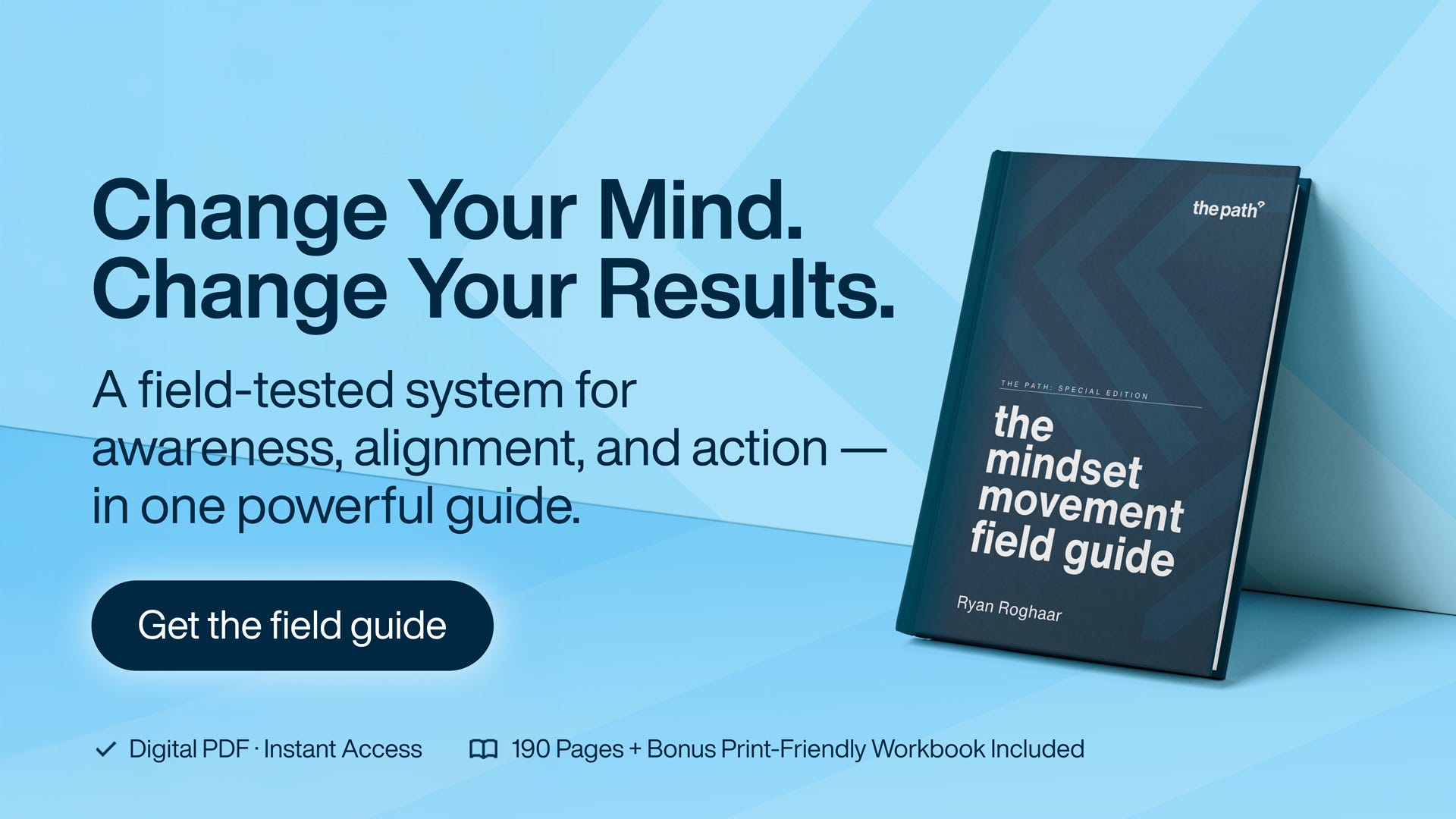
If you’re ready for life to feel more intentional, more aligned, and more within your control, this guide gives you the structure to make that shift real. Your next version starts with a single decision. Get the field guide
Path Picks
Cool stuff to help you forge your path to greatness.
Note: The Path Weekly is reader-supported. As such, I may be using affiliate links below. If you want to support the newsletter at no additional cost to you, please consider using the links below. If you’d rather not, most items below are widely available anywhere you want to shop. Thanks! –R
Reading list
If you're looking to go deeper on the themes from this week's newsletter, here are a few books that pair well with the conversation and offer a broader perspective:
The Millions Within — David Neagle The backbone of this series. A clear, practical look at how belief, desire, and universal law interact — and what it actually means to live as if success is your birthright rather than an exception.
The E-Myth Revisited by Michael E. Gerber A practical look at why so many people stay trapped inside structures that cannot scale — and what it really means to build a vehicle that grows with you rather than around you.
Designing Your Life by Bill Burnett & Dave Evans A grounded, research-backed approach to creating a life and career aligned with who you’re becoming, not who you were. A perfect complement to the BRIDGE framework.
Range by David Epstein A compelling argument for embracing pivots, broad skills, and nonlinear paths — especially helpful when you’re evaluating whether your current vehicle matches your long-term potential.
So Good They Can’t Ignore You by Cal Newport A sharp counterbalance to pure passion-based advice, emphasizing skill, structure, and the real mechanics of opportunity creation.
Atomic Habits by James Clear Not about mindset per se, but about the structural alignment and identity-based action required to express the internal shifts you’ve made. A clean fit for the “G” and “E” of BRIDGE.
Work with me
Ryan Roghaar - Fractional CMO/Creative Director/Art Director: https://rogha.ar/portfolio
R2 - Creative Services for Agencies and SMBs: https://www.r2mg.com
***NEW*** R2 Health - Healthcare branding & strategy that connects, inspires trust, and drives results. Powered by R2. https://www.r2mghealth.com
Eggs! The Podcast: https://www.eggscast.com
Would you like a personal introduction to any of the incredible leaders featured in The Path Weekly to explore business or other collaborative opportunities?
Contact me here to learn more about my B2B matchmaking service.
Get featured
Do you want to be featured in a future edition of The Path Weekly?
Contact me to learn more.