



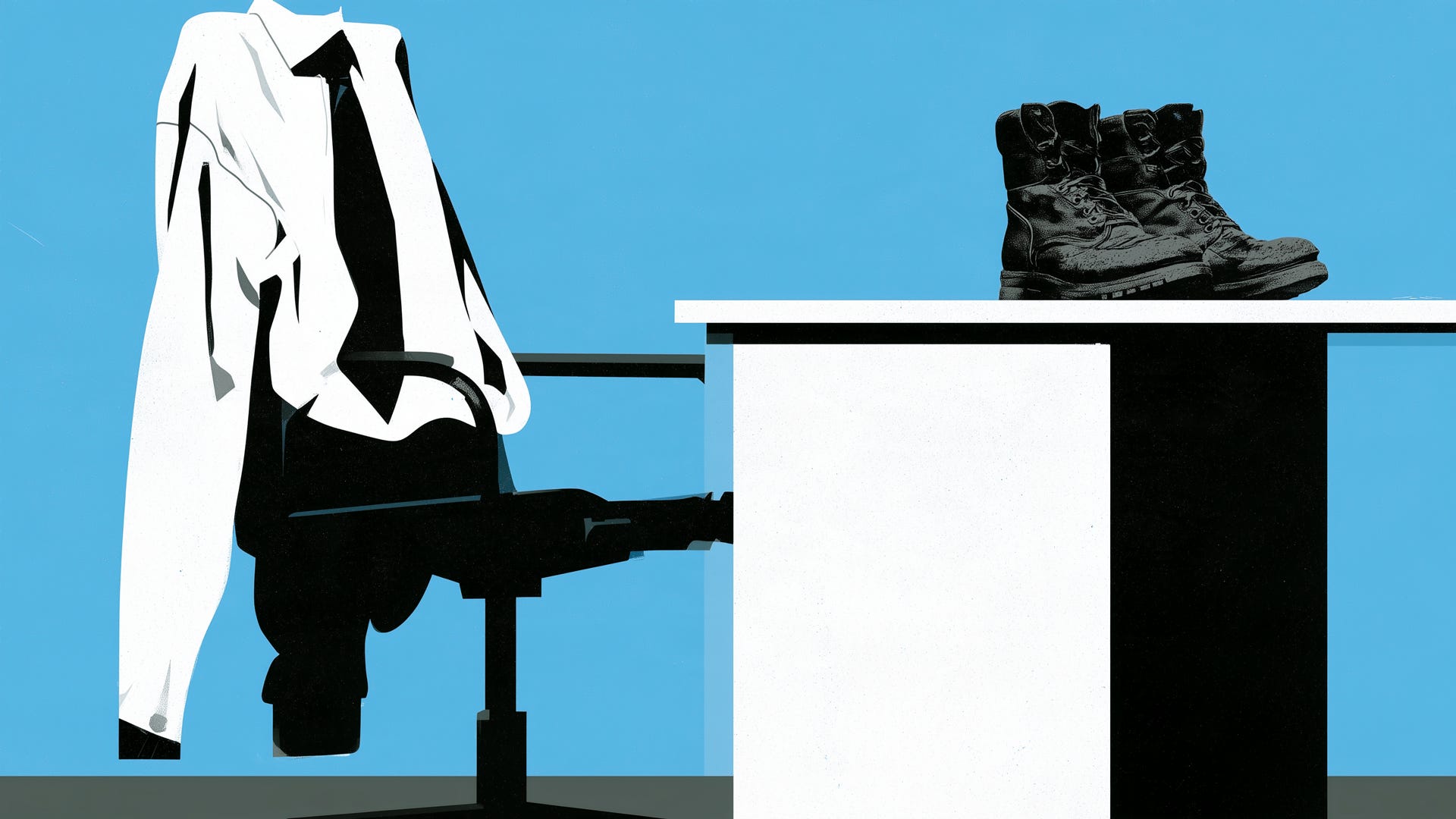
For most of my adult life, the safest career advice sounded something like this: get educated, learn to work with information, and move as far away from manual labor as you can. The future belonged to knowledge workers. The people who could analyze, strategize, communicate, design, code, manage, and make decisions would have the leverage. Physical work would eventually be automated, outsourced, or pushed down the economic ladder — AI is starting to make that assumption look shaky.
The first jobs being meaningfully compressed by AI aren’t electricians, machinists, welders, HVAC technicians, or the people building semiconductor fabs and pharmaceutical plants. They’re writers, analysts, programmers, designers, researchers, marketers, and plenty of other people whose careers were built around producing and manipulating information. A huge amount of work that once required a reasonably expensive human being can now be done faster, cheaper, and often surprisingly well by software. That doesn’t mean those professions disappear. It does mean the economics around them start to change.
At the same time, the physical economy is running into a very different problem: scarcity. We need people who can actually build things. Data centers need electricians. Semiconductor facilities need highly trained technicians. Pharmaceutical manufacturing requires clean rooms, specialized equipment, quality systems, maintenance, logistics, and an enormous amount of infrastructure. These aren’t the old factory jobs people picture when someone says “blue collar.” Many of them are highly technical, highly specialized, and increasingly hard to staff.
That creates an interesting inversion. Intelligence is getting cheaper. Physical capability is getting more valuable.
I can already see pieces of this in my own work. AI has allowed me to do things that would have required an entire team not very long ago. I can prototype software, work through technical problems, generate research, test positioning, build systems, and move ideas much further on my own before I need outside help. That is an incredible advantage, but it also means the market needs fewer people to produce the same amount of intellectual output. Multiply that across millions of businesses and it becomes pretty obvious why the old white-collar premium may not hold the way we once assumed it would.
Meanwhile, somebody still has to build the factory. Somebody has to wire the data center, install the equipment, maintain the machines, manufacture the drugs, move the materials, and make the physical world work. Robots will eventually take on more of that too, but “eventually” matters. Software can spread almost instantly. Rebuilding the physical economy takes years, enormous amounts of capital, and a workforce we haven’t spent nearly enough time developing.
That tension came up repeatedly in my recent conversation on Eggs! The Podcast with Tony Paquin, founder and CEO of iRemedy. Tony has spent roughly four decades building technology companies, working across software, healthcare, and global supply chains. His view is that we may be moving out of an economy organized primarily around information and into something much more physical: a production economy where manufacturing, infrastructure, energy, and skilled labor become increasingly valuable precisely because AI is making so much knowledge work abundant.
From Software to Supply Chains

Tony Paquin has spent roughly four decades building technology companies, often in markets that were on the verge of significant change. He started as a programmer almost by accident, writing software for an insurance agency after deciding that a $50,000 software package seemed excessive for a small business. That project eventually grew into a major insurance-software company. Later, he built a web-based electronic medical records business that went public on Nasdaq, pulling him deeper into healthcare and setting the stage for much of the work that followed.
After leaving that company, Tony began consulting with hospitals and ultimately worked with roughly 600 across the country. His work increasingly centered on what he called “retail healthcare” and eventually on building and operating hospital pharmacies. That experience exposed him to a problem that would become central to his career: the enormous complexity and fragility of the global healthcare supply chain. Today, he is the founder and CEO of iRemedy, a healthcare supply company that uses technology and AI to monitor global manufacturing, sourcing, and supply-chain risk.
That work became especially consequential during COVID. Working with the federal government, Tony and his team helped source needles and syringes for the vaccination effort, ultimately chartering 135 Boeing 747s and importing roughly 1.2 billion medical items. The experience put him on the front lines of the global competition for critical medical supplies and later became the basis for his book, The End of Us. It also gave him a particularly unusual vantage point on what comes next: a technologist who has spent his career building software, but who now sees manufacturing, infrastructure, and skilled physical work becoming increasingly important in an AI-driven economy.
Where the Value Is Moving
Tony’s argument isn’t that white-collar work disappears or that everyone should suddenly learn a trade. It’s that AI is changing what’s scarce—and scarcity has a funny way of changing what the market is willing to pay for.
“This economy is gonna switch from the information age to the production age.”
Actionable insight: Pay attention to where capital is moving, not just where the headlines are. The next wave of opportunity may be less about producing more information and more about the infrastructure, manufacturing, energy, logistics, and specialized labor required to turn ideas into something physical.
“If you were to go blue collar versus white collar, which one makes more money? Everybody would immediately go, the white collar guy does... That’s not going to be true much longer.”
Actionable insight: Old assumptions about career value are exactly that: assumptions. Whether you’re building a company or advising your kids about careers, it’s worth looking at actual supply and demand instead of relying on the hierarchy of jobs we inherited from the last economy.
“The blue collar people are gonna see their salaries double, triple, and quadruple while they find their niches in the market.”
Actionable insight: The opportunity isn’t necessarily in generic labor. It’s in specialization. The people who understand sophisticated equipment, clean rooms, advanced electrical systems, automation, precision manufacturing, or other difficult physical systems are building expertise that cannot be copied and distributed at the speed of software.
“These aren’t like dirty, low-paying jobs... building these data centers, building a pharmaceutical manufacturing company is going to be sophisticated. These are going to be good quality jobs.”
Actionable insight: We may need to update the picture in our heads when we hear “manufacturing.” A modern semiconductor fab, pharmaceutical plant, or AI data center bears very little resemblance to the industrial-era factory floor most people imagine. The work has changed, and perception is lagging behind.
“I’m gonna use it as a force multiplier, but I gotta have a basic force to multiply.”
Actionable insight: AI becomes far more useful when it sits on top of real expertise. Knowing your craft gives you something to challenge the machine with—judgment, context, taste, experience, and the ability to recognize when the answer looks convincing but is wrong.
“They’re not thinking for themselves anymore. They’ve just handed it over to Claude. That’s weak and lazy.”
Actionable insight: There’s a huge difference between increasing your capacity and outsourcing your judgment. If AI is doing the thinking instead of helping you think, efficiency may go up while your actual value goes down.
“I think there’ll be more opportunity created in the next five years than the last twenty-five years.”
Actionable insight: The useful response to disruption isn’t panic, and it isn’t pretending nothing is changing. It’s getting close enough to the change to see where new constraints, shortages, and unsolved problems are appearing. Opportunities usually show up first there.
The Advantage Goes to the Adaptable
The mistake would be to read all of this as a simple contest between white-collar and blue-collar work. It isn’t. The deeper shift is that technology keeps changing what the market considers scarce, and scarcity is what creates value. For decades, access to information and the ability to process it were scarce enough to command a premium. AI is making both dramatically more abundant.
That means the advantage increasingly belongs to people who can combine judgment, expertise, and adaptability with things that remain difficult to automate. Sometimes that will mean knowing how to build, fix, manufacture, or operate something in the physical world. Sometimes it will mean having enough domain expertise to use AI better than everyone around you. In either case, the common denominator is the same: you have to bring something meaningful to the machine. Tony’s point about needing “a basic force to multiply” may be one of the most useful ways to think about what comes next.
We’ve been through technological transitions before, and they rarely reward the people who spend the most time arguing about whether the change should be happening. They reward the people who understand where the change is creating new problems, new shortages, and new forms of demand. AI will undoubtedly eliminate some work, reshape a lot more, and create opportunities we can’t fully see yet. The useful question isn’t whether the old rules are changing. They clearly are. It’s whether we’re paying close enough attention to notice where the new ones are being written.
Thanks for reading.
—Ryan
If you’re ready for life to feel more intentional, more aligned, and more within your control, this guide gives you the structure to make that shift real. Your next version starts with a single decision. Get the field guide
Ready for more?
Catch the interview in its entirety on Eggs! The Podcast.
Don’t miss a show! Subscribe on Spotify, Apple Podcasts, or really anywhere great podcasts are found.
Path Picks
Cool stuff to help you forge your path to greatness.
Note: The Path Weekly is reader-supported. As such, I may be using affiliate links below. If you want to support the newsletter at no additional cost to you, please consider using the links below. If you’d rather not, most items below are widely available anywhere you want to shop. Thanks! –R
Reading list
If you're looking to go deeper on the themes from this week's newsletter, here are a few books that pair well with the conversation and offer a broader perspective:
The End of Us: A Story of Death, Deception and China’s Deadly Grip on US Healthcare — Tony Paquin
Tony’s newest book grows directly out of the experience he described on the show: sourcing enormous quantities of medical supplies during COVID and seeing firsthand how dependent the United States had become on overseas manufacturing. Part supply-chain exposé and part real-world thriller, it offers useful context for the larger argument that domestic production is becoming a strategic issue, not simply an economic one.The Retail Healthcare Revolution — Tony Paquin
Written much earlier in Tony’s career, this book captures another moment when he saw an established industry beginning to change underneath itself. The focus is healthcare consumerism rather than AI or manufacturing, but it’s an interesting companion to this week’s conversation because it shows the pattern Tony has followed for decades: identify where technology is changing the economics of an industry, then get there early.Shop Class as Soulcraft — Matthew B. Crawford
This one feels almost eerily well suited to this week’s theme. Crawford challenges the long-standing assumption that knowledge work is inherently more valuable than skilled manual work and makes the case for craftsmanship, technical competence, and actually knowing how to make and fix things. It was written well before the current AI boom, which may make its argument even more relevant now.The Coming Wave — Mustafa Suleyman with Michael Bhaskar
Suleyman, a co-founder of DeepMind and now CEO of Microsoft AI, looks at the extraordinary speed with which AI and other powerful technologies are developing—and the economic, political, and institutional problems that come with trying to control them. If Tony’s argument describes where work may be heading, this book helps explain the technological force pushing it there.The Technology Trap — Carl Benedikt Frey
Frey takes the much longer historical view, examining what previous waves of automation actually did to workers, wages, political power, and economic opportunity. It’s a useful antidote to both AI utopianism and AI panic: technological progress can create enormous prosperity while still producing very uneven consequences along the way.
More to explore
Learn more about our featured guest — start here:
iRemedy Healthcare — Tony’s healthcare distribution and supply-chain intelligence company, combining direct distribution with AI-powered procurement and supply-chain monitoring. Visit iRemedy Healthcare
The End of Us — Learn more about Tony’s book on America’s dependence on foreign medical manufacturing and the supply-chain vulnerabilities he encountered firsthand. Explore The End of Us
The Supply Side Podcast — Tony’s show exploring healthcare supply chains, reshoring, national security, pharmaceutical infrastructure, and related issues. Listen to The Supply Side on Spotify
Tony Paquin on LinkedIn — Follow Tony for his writing and commentary on AI, healthcare, manufacturing, supply chains, and entrepreneurship. Connect with Tony on LinkedIn
iRemedy Publications & Newsroom — More of Tony’s writing, podcast appearances, Senate testimony, company updates, and research on the healthcare supply chain. Explore iRemedy’s publications
Would you like a personal introduction to this or any of the incredible leaders featured in The Path Weekly to explore business or other collaborative opportunities?
Contact me here to learn more about my B2B matchmaking service.
Want to put your brand in front of 13,000+ business and technology leaders each week? Contact me to learn more about sponsorship opportunities.
Work with me
RŌG Health - A commercial readiness and strategy firm for medtech companies, helping CEOs identify what’s blocking growth and make clear, de-risked decisions around commercialization, partnerships, and fundraising.
https://roghealth.com
Ryan Roghaar - Artist/Creative Director/Author
https://rogha.ar
Get featured
Do you want to be featured in a future edition of The Path Weekly?
Contact me to learn more.